Kevin Earl Dayhoff Art One-half Banana Stems

Kevin Earl Dayhoff Art One-half Banana Stems https://kevindayhoffart.blogspot.com/ Authority Caroline Babylon, Treasurer. Address: PO Box 124, Westminster MD 21158 410-259-6403 kevindayhoff@gmail.com Runner, writer, artist, fire & police chaplain Mindless ramblings of a runner, journalist & artist: Travel, art, artists, authors, books, newspapers, media, writers and writing, journalists and journalism, reporters and reporting, technology, music, culture, opera... For Westminster and Carroll County Maryland community: Dayhoff Westminster Soundtrack: https://kevindayhoff.blogspot.com/ 2Nov2025

Tuesday, November 28, 2006

20061127 Be the best you can be.

Be the best you can be.

Overcoming obstacles

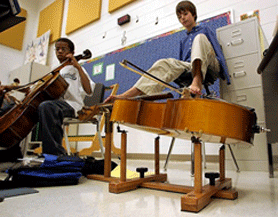
Pictured above: George Dennehy, right, plays first-chair cello at Oak Knoll Middle School in Hanover County, Va.. George, born with bilateral upper-limb deficiency, has no limbs beyond his shoulder blades and has learned to do almost everything with his feet. (Lindy Keast Rodman, Associated Press)

Although I have a reputation for reading (too) many newspapers, I’ll tell ya a secret – I really scan the articles and just look at the pictures. Often the articles have too many big words for me.

In all seriousness, I am a newspaper photograph junkie and I had noticed Lindy Keast Rodman’s work in the
Richmond Times-Dispatch some time ago.

I found this picture in “
The Day in Pictures” section of the Baltimore Sun web site. I recognized the name of the photographer and went to the Richmond Times-Dispatch web site to try and find the picture on the web site…

I did not find the picture, but I found the
article for which the picture may very well have accompanied. The article, “With feet and toes, young cellist makes beautiful music,” By HOLLY PRESTIDGE, Richmond Times-Dispatch; is worth a quick read. You can find it here.

It begins:

HANOVER, Va. - George Dennehy sits first chair in the cello section of the string orchestra at Oak Knoll Middle School in Hanover County.

As he leans back slightly on a stool, the toes on George's right foot move over the cello's strings as the toes on his left foot control the bow.

George's feet are his hands; his toes are his fingers. He was born with bilateral upper-limb deficiency, so he has no limbs beyond his shoulder blades.

He has learned to do almost everything with his feet _ typing on the computer, eating, setting the table, opening doors, playing the cello.


Read the rest here. (I do not know if the Richmond Times-Dispatch uses permalinks – so if you are accessing this post and the link is dead, e-mail me at kevindayhoff(at)gmail.com and I’ll load the rest of the article…)

Thank you Richmond Times-Dispatch, Holly Prestidge and Lindy Keast Rodman, for a great and uplifting story.

This great picture of Mr. Dennehy provides a bit of a springboard to mention the importance of Special Education programs in our school systems and the subject of mainstreaming.

When at all possible, I believe passionately about mainstreaming, i.e., integrating children with disabilities or special needs into the classrooms as much as possible. The rewards for all the children and society in general far outweigh the expense.

Give a child a chance and they will engage, adapt and overcome every time; provided they are given the proper opportunity to excel; given proper support and allowed to develop compensatory approaches to many of the day-to-day activities we tend to accept as routine.

And this is win-win for everyone.

Kevin

20061127 An incredible story about an amazing swimmer


An incredible story about an amazing swimmer
November 27th, 2006

For a related post, please see, "2oo61127 Be the best you can be,"

Top photo: Paralympian Jessica Long holds multiple swimming world records. "I like being chased," she says. (Sun photo by Doug Kapustin) Nov 17, 2006 For the Related story, please see: Catch me if you can in the Baltimore Sun.

Bottom photo: Paralympian Jessica Long, 14, of Middle River, holds multiple swimming world records. "I like being chased," she says. (Sun photo by Doug Kapustin) Nov 27, 2006

“Catch me if you can,” From the Baltimore Sun By Paul McMullen, Sun reporter, November 27, 2006
At 14, Jessica Long of Middle River is winning gold and setting records with the U.S. Paralympic swim team

Jessica Long's proficiency in the pool is apparent after a few strokes. Bobbing up and down on the breaststroke, she's indistinguishable from the practice partners in her lane, but something seems missing from her otherwise impeccable freestyle form.

The less splash swimmers make with their hands, the faster they go, but Long's kick leaves a curiously scant trail.

The 14-year-old from Middle River has mastered the pull and push of water well enough to set multiple world records, but her athleticism is fully comprehended only on the pool deck. A double amputee below the knees, Long walks on prosthetic legs.

On Thursday morning, Long left her parents and siblings for Thanksgiving in Chicago, joining the other members of the U.S. Paralympic swim team.

20061127 The US Census Bureau breaks society down into five core generational segmentations

The US Census Bureau breaks society down into five core generational segmentations

Hat Tip: Mrs. Owl

I’ve always been fascinated with some of the communication dysfunction that occurs between men and women, different races and cultures and between generations.

Mrs. Owl was kind enough to e-mail this brief overview as to communication between generations. I enjoy speaking to young adults in the Carroll County Public Schools… and with that and in my role as an uncle, I have always liked to think that I do a fairly good job at reaching the youngest generation; however, I never-the-less worry that I need much improvement.

Anyway, I hope that you agree that the following is an informative introduction to the subject of intergenerational communication…


Listening – Generational!
By Dr. Jeffrey Magee, PDM, CSP, CMC

Executive Summary: Listening to individuals from the generational footprint they bring to the conversation can drastically change the outcome – connect with them at their level and attain success, insist upon communicating from your level solely and your guaranteed failure!

With the diverse environments you live and work today, there is something more important than just gender and race when it comes to really communicating and listening to others for success. Consider the five diverse generational segmentations (COACHING for IMPACT ©2003 by Dr. Jay Kent-Ferraro and Dr. Jeffrey Magee,
www.JeffreyMagee.com/library.asp) in the work place today, and some of the similarities and more importantly the enormous difference between how each one operates and processes.

Effective leaders merely make observations, not judgments of right versus wrong or good versus bad, in reflecting upon the differing age segmentations in an organization and thus ways to better connect with each.

The United States Census Bureau breaks society down into five core generational segmentations (birth through death) and if we are to simply use these same five segmentations in the work place, we could segment individuals (yes we are making generalizations here, and there can always be an exception!) into categories with unique traits or characteristics, which could serve as guide posts of how to frame your communication exchange to solicit greater listening and awareness.

Consider the five generational segmentations and the ABCs (Attitudes, Behaviors, and Characteristics) of each for better connections:

1. Centurion (those over 55 years of age; exit point employees) – more structured, formal, conservative, dedicated, and loyal, identity is rooted in what one does, change resistant …

2. BabyBoomers (those from 38 to 55 years of age) – more status driven, materialistic driven, opinionated and ego driven, live to work …

3. Generation X (28 to 38 years of age) – entitlement expected, more outgoing and impatient, question authority and norms more, self indulgent, live for the now …

4. Generation Y (22 to 28 years of age) – More social and relationship driven, work to live, not as class conscious, highly educated, more liberal, change accepting …

5. Generation MTV (17-21 years of age; entry point employees) – looking for association causes to be dedicated to, more structured and accepting of others and situations, concerned for the future and consideration of their peers, live for the now with a reflection on the future, very tech savvy …

When listening to others, listen from the vantage point of the generational segmentation as a footprint from where they come from and you will have a greater awareness of why one says what one says and how to connect with them more effectively.

####